
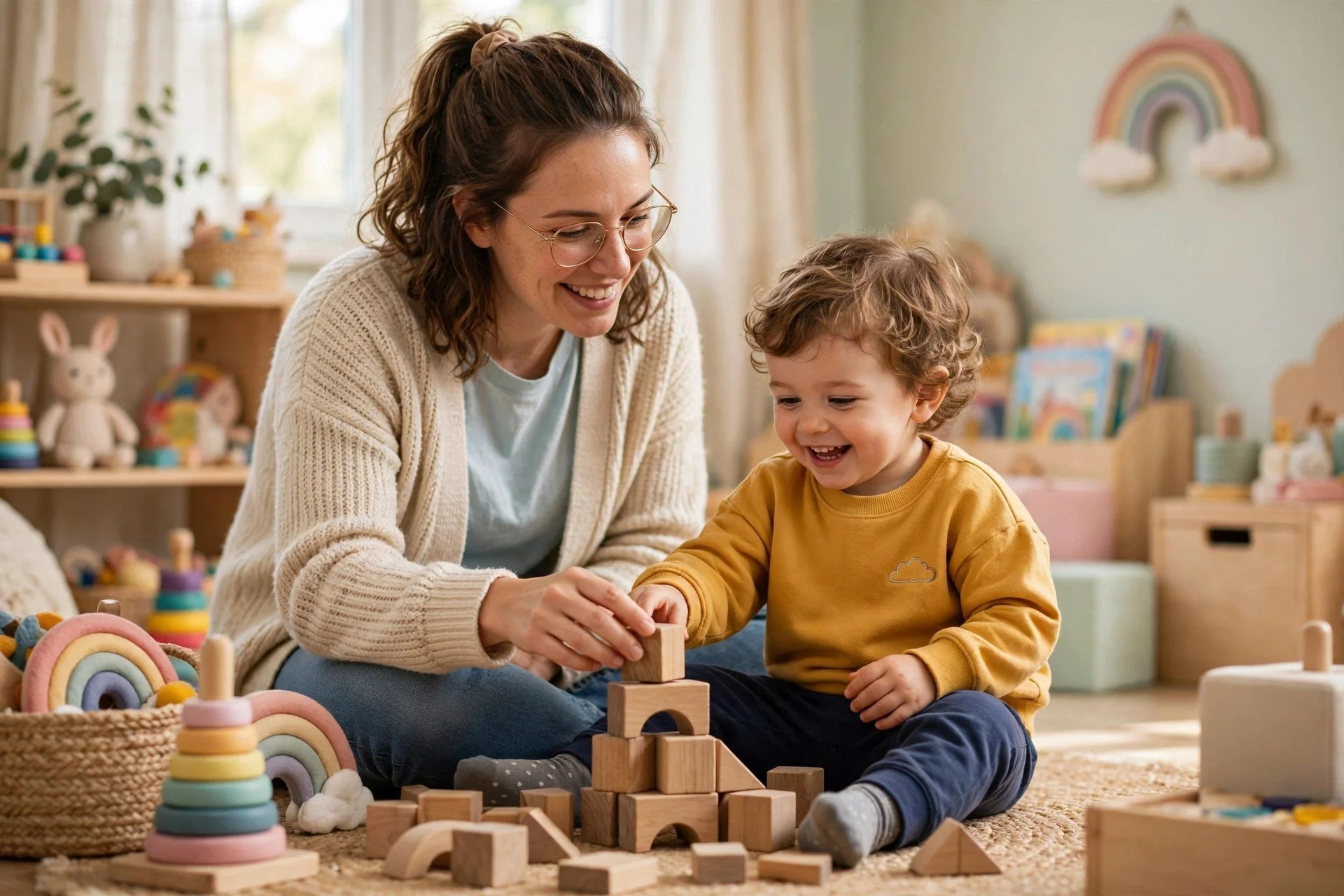
For many parents, the toddler years bring an unexpected question: my child is not talking, playing, or connecting the way other children seem to — should I do something now, or wait and see? If you are asking that question, you are already doing the right thing. ABA therapy for toddlers is designed for exactly this stage of life. It uses play, familiar routines, and gentle, positive teaching to build communication, social, and everyday skills while your child's brain is developing fastest.
What Is ABA Therapy for Toddlers?
ABA — Applied Behavior Analysis — is an evidence-based approach to understanding how children learn and behave. It breaks big skills into small, teachable steps, rewards progress, and uses data to check what is working. Our complete guide to what ABA therapy is explains the foundations in plain language. For toddlers, ABA looks nothing like a classroom lesson. Sessions are play-based and follow your child's interests: a therapist might build communication during snack time, or practise turn-taking with a favourite toy. Every program is designed and supervised by a Board Certified Behavior Analyst (BCBA), who assesses your child and sets individual goals. Trained Registered Behavior Technicians (RBTs) deliver the day-to-day sessions and record progress at every visit.
Signs Your Toddler May Benefit From an Evaluation
Every child develops at their own pace, and one late milestone alone is rarely a cause for alarm. Seek an evaluation, however, if you notice several of these early signs:
- Limited or no spoken words by around 18 to 24 months, or a loss of words your child once used
- Rarely responding to their name, or limited eye contact and shared attention
- Little pointing, waving, or other gestures to communicate wants and needs
- Repetitive behaviours such as hand-flapping, spinning objects, or lining up toys
- Strong distress at small changes in routine, sounds, or environments
- Limited interest in playing with other children or in pretend play
An evaluation does not commit you to anything — it simply replaces worry with information. A diagnostic evaluation is the usual first step, and it helps determine whether ABA therapy is appropriate for your child at all.
What Does a Toddler ABA Session Look Like?
Parents are often relieved to learn how natural toddler sessions feel — no desks, no pressure to perform. Therapists use proven ABA therapy techniques adapted for very young children:
Play-based learning. Teaching is woven into games, songs, and activities your child already enjoys — for a toddler, play is learning.
Natural environment teaching. Skills are practised where they will actually be used: at the table, on the playground, or during everyday routines.
Positive reinforcement. When your child tries a new sound, word, or skill, that effort is immediately rewarded with praise or a favourite activity. Success builds the motivation to try again.
Small steps, measured often. Goals are broken into tiny, achievable steps, and progress is recorded in every session, so the BCBA can change what is not working and share clear updates with you.
Skills ABA Therapy Helps Toddlers Build
Goals differ for every child, but most toddler programs focus on the building blocks later learning depends on:
- Communication: requesting, labelling, imitating sounds and words, and using pictures or gestures when speech is still emerging
- Social skills: eye contact, joint attention, turn-taking, and early play with others
- Daily living skills: feeding, dressing, brushing teeth, and toilet-learning readiness
- Play skills: exploring toys appropriately, imitating play, and early pretend play
- Behaviour support: understanding why challenging behaviour happens and teaching safer ways to communicate needs
These early gains matter beyond toddlerhood. They support a smoother start at preschool and, later, learning in a classroom — one reason many families also explore how in-school ABA benefits a child's development as their child grows.
When Should a Toddler Start ABA Therapy?
As soon as a concern is confirmed, rather than after months of waiting. Research on early intervention for autism shows that children who start earlier — often between 18 months and three years — tend to make stronger progress, because the brain is especially responsive then. That does not mean there is a deadline you can miss — children can benefit from ABA at many ages. But trusting your instincts early gives your child the longest possible runway. You do not need to wait for a formal diagnosis before asking questions, either; many providers will guide you through the evaluation and insurance process.
Parents Are Part of the Therapy
ABA works best when it does not stay inside the therapy room. Skills should carry over to breakfast, bath time, and the playground — and that is where you come in. Good providers coach parents as partners. Through parent training, you learn the same strategies your child's team uses: how to prompt a request, reinforce a new skill, and respond calmly to challenging moments. Our guide to ABA therapy at home has simple tips and tools you can use straight away. Short, consistent practice at home often makes progress faster, because your child is learning where they feel most secure — with you.
How to Choose an ABA Provider for Your Toddler
When you search for ABA therapy near you, look beyond the nearest address. Ask any provider you consider:
- Will a BCBA assess my child, design the program, and supervise it directly?
- Is therapy play-based and individualised, or a standard program used for every child?
- How will you involve us as parents, and how often will we receive progress updates?
- Where does therapy take place — in a centre, at home, in school, or a combination?
- Do you accept our insurance, and will you help us verify coverage?
At Pieces Behavioral Group (My Pieces), toddler programs are built around each child's own assessment and personal behaviour plan. Our ABA therapy programs include early intervention, skill building, school-based ABA, social skills workshops, and family support and training, delivered by BCBA-led teams in Winter Park and across Central Florida, including our ABA therapy in Orlando services. We accept Cigna, Aetna, Florida Medicaid, Tricare, Florida Blue, and most major insurance providers.
Frequently Asked Questions
How many hours of ABA therapy does a toddler need? There is no single number. After an assessment, the BCBA recommends hours based on your child's needs and goals — some toddlers start with a few hours a week, others benefit from more intensive support.
Is ABA therapy appropriate for very young children? Yes, when delivered properly. Modern toddler ABA is play-based, positive, and assent-focused — sessions stop or change if a child is distressed. Always choose a provider where a BCBA designs and supervises the program.
How long before we see progress? Many families notice small changes — a new gesture, sound, or routine — within the first few weeks. Bigger skills build gradually over months, and your BCBA should share session data regularly so progress is visible.
Does insurance cover ABA therapy for toddlers? In Florida, most major plans cover ABA therapy for children with an autism diagnosis, and Medicaid may also cover eligible children. A provider should verify your benefits and explain any costs before therapy starts.
Taking the First Step
Wondering whether your toddler needs support is not a failure as a parent — it is advocacy. An evaluation gives you clear answers, and starting early gives your child support at the age when it can help most. If you would like to talk through your child's development, contact the My Pieces team. We will listen first, explain your options honestly, and help you decide on the next step.